It was the morning of Sept. 11, 2001, in New York City, NY. Everyone was getting ready for their day; some were already on their way to work, and some were enjoying a nice cup of coffee. Meanwhile, back in Portland, ME, 19 hijackers were passing through security to board on four different flights.
At 8:46 a.m. when the North Tower of the World Trade Center was hit, 76 passengers along with 11 crew members were killed instantly. At 9:03 a.m., the South Tower of the World Trade Center was hit, 51 passengers, along with nine crew members, lost their lives. At 9:37 a.m., the Pentagon was hit, where 53 passengers, six crew members and 125 military personnel, along with civilians, lost their lives. At 9:59 a.m., the South Tower collapsed, where more than 800 civilians that were in the surrounding areas were killed. At 10:03 a.m., the final plane crashed in a field near Shanksville, Pennsylvania, where 33 passengers and seven crew members were killed. At 10:15 a.m., the Pentagon E Ring collapsed, and at 10:28 a.m., the North Tower collapsed, killing more than 1,600 people.
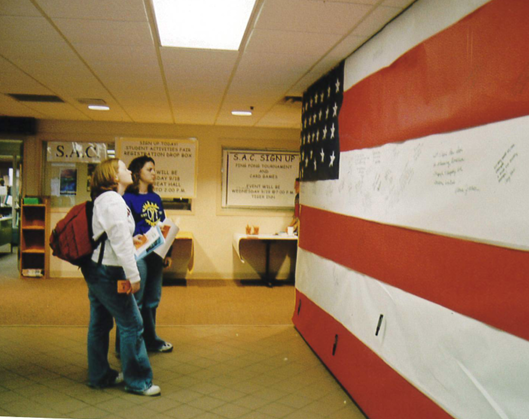
After the attack, the United States came together as one to help after the destruction. Many Doane students were shocked, but some were confused and upset about the tragedy.
“Life went on… Classes weren’t canceled, and the administration didn’t shut down… But how could any of us, reeling from such a major event, be expected to study?,” a student told OWL reporters on Sept. 13th, 2001. “When other schools across the nation are closing, why do we stay open?”
This year was the 25th Anniversary of the 9/11 attacks on the World Trade Center, and although most of the student body was not born at the time of the events, some professors and faculty still remember that day like it was yesterday. Associate Professor of Practice and LAR Coordinator, J.L. Vertin, was one of those faculty members.
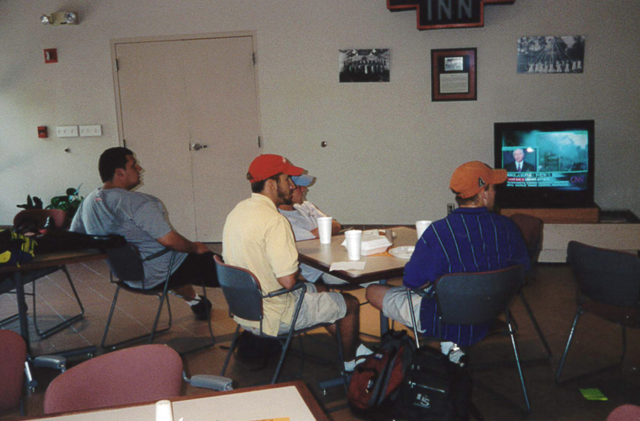
Vertin discussed how it started as a normal day; he was dropping his daughter off at his mother-in-law’s house, where they proceeded to watch the live footage on the TV.
“Once the first plane hit, that kind of thing, then it started getting all over the news, and so we were watching it, and I will never forget being in her living room and then trying to teach,” Vertin said.
When Vertin got to campus on that day, many students were unaware of the attacks that were going on in New York. With that being said, faculty and staff were left trying to process not only the events that were happening but also their normal responsibilities.
“There were lots of students that were unaware because there weren’t phones like we have now,” Vertin said. “There were several of us that were having to bring it kind of to their attention.”
While the events unfolding across the country left many in shock, Vertin said there was also a sense of uncertainty about what would happen next.
“I think it wasn’t quite rage, but there was definitely some anger about, like, how does this happen?” Vertin said. “And then what could possibly happen next?”
Despite the uncertainty, Vertin said he did not fear for his own safety. Living in the Midwest, his thoughts were focused more on what the attacks meant for the country as a whole.
In the days and weeks following the attacks, communities across the country found ways to help. Vertin said one of the things that stayed with him the most was seeing people from different backgrounds come together in response to the tragedy.
“I remember thinking this from a patriot standpoint. It’s probably the first time I’ve felt patriotism in that way, because you could see it everywhere,” Vertin said.
Twenty-five years later, however, the experience of 9/11 has changed for many Americans. For current Doane students, the attacks are a historical event rather than a memory they personally experienced.
Although the immediate emotions surrounding the attacks have faded with time, Vertin said firsthand experiences can bring those emotions back. Vertin recalled visiting Ground Zero and the 9/11 Memorial Museum in New York City.
“Then it very much becomes that sort of emotionally raw thing again, because you remember all of the stories that went behind it,” Vertin said.
For students who were not alive on 9/11, honoring the attacks can be difficult. Many have learned about the events through history lessons, documentaries, photographs and stories from people who experienced them firsthand.